
Why subagents produce shocking bills
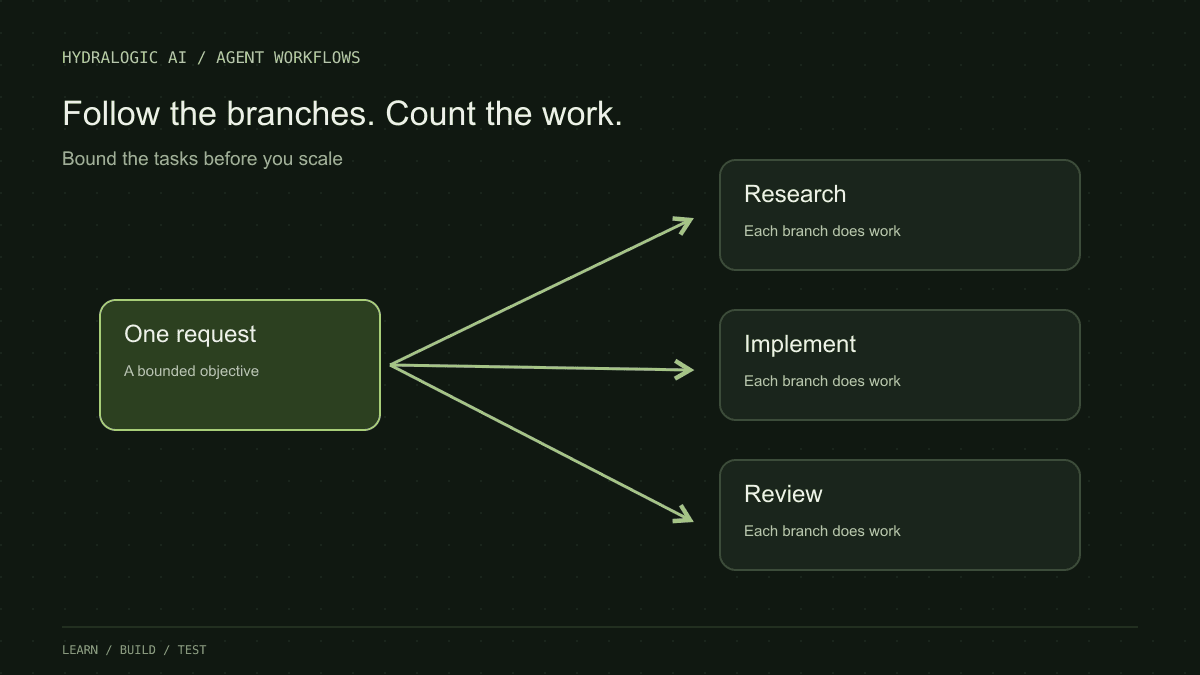
Builder · Agent Workflows
“One command ran for two hours and the bill was four figures.”
The stories circulating in 2026 are specific enough to be worth taking seriously: a single slash command fanning out to dozens of parallel subagents for a couple of hours, with an estimated cost in the thousands. One team reported tens of thousands over three days.
We have not reproduced these numbers ourselves and you should treat them as reported rather than measured. The mechanism, though, is not mysterious, and it is worth understanding before you write your first fan-out.
The mechanism
A subagent is not a cheap function call. It is another model instance with its own context window, and it pays to fill that window before it does any useful work.
Three things compound:
Each subagent re-reads. Twenty subagents exploring a codebase means twenty separate passes of file reading, each one billed. Nothing is shared between them.
Parallelism removes the brake. One agent working sequentially gives you two hours of chances to notice. Twenty agents working at once spend twenty times as fast, and the first signal is the invoice.
Caching helps least here. Prompt caching rewards a stable prefix that gets reused. Fresh subagents with different prompts have no shared prefix to hit, so the discount you get in a normal session largely does not apply.
The ceiling to put on it
Decide the fan-out width before you run it, not after. “However many it takes” is not a plan. Five subagents that each return something useful beat fifty that each re-read the same directory.
Give each one a narrow brief and a small result. A subagent that returns a paragraph is doing what subagents are for. One that returns a transcript has just moved your context problem somewhere more expensive.
Watch the first run, in full. Run any new fan-out once, sequentially, and look at what it actually did. Most runaway costs are a loop that was never meant to be a loop.
Put a spend alert on the account. Not a limit you plan to hit — a number that means something has gone wrong. Every large bill in these reports was discovered afterwards.
The one-line version
Subagents trade money for context isolation. That is a good trade when the work is genuinely separable and a terrible one when it is not, and the difference is worth ten minutes of thought before the first run rather than after it.
Written by Hydralogic AI, not yet reviewed by a second person. This post describes problems reported by others rather than ones we measured ourselves — the reasoning is ours, the numbers are theirs. Check them below.
A little practice. A clearer next step.
Twelve free questions with explanations. Choose your track. No account, no card.